

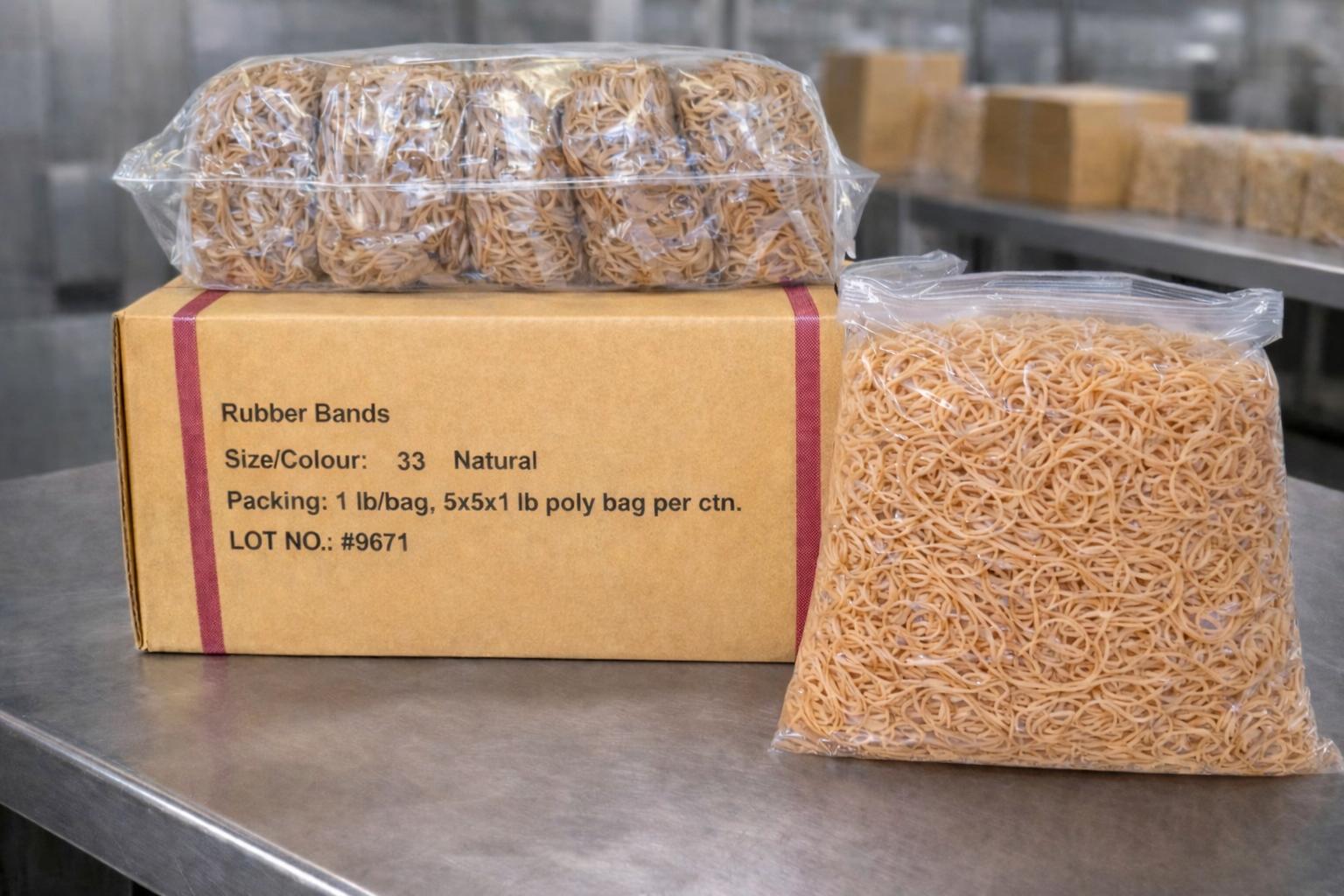
Elastic fastening quality shows up at the packaging line before it appears in purchasing reports: variation in stretch changes operator rhythm, feed behavior, and bundle integrity. The cost of getting bulk rubber bands wrong is avoidable line attention, replenishment friction, and reduced confidence in finished goods handling. Strong sourcing keeps fastening performance aligned with throughput goals while giving procurement a cleaner view of inventory risk.
Across mature packaging operations, the better pattern is specification-led purchasing rather than purely price-led replenishment. This guide treats rubber bands as engineered consumables, not incidental supplies. That distinction matters because a low-priced band can still create expensive operational drag if material composition, recovery, and supply reliability are not reviewed together. A value-driven distributor conversation should cover latex content, sizing discipline, packaging format, and fulfillment responsiveness, so teams can protect uptime with a practical and repeatable buying standard.
Why Bulk Rubber Bands Require Careful Evaluation
Procurement teams tend to see band quality most clearly under tension, where recovery, surface feel, and dimensional consistency determine whether packaging rubber bands apply cleanly. A band that feels acceptable in a sample bag can behave differently when fed repeatedly, stored near equipment heat, or stretched around varied bundle profiles. High-consistency material is widely favored because it supports smoother handling and materially lower interruption risk.
Careful evaluation should balance strength, elasticity, and end-of-use expectations. Natural latex compounds are often selected for resilient stretch and snapback, while naturally biodegradable options can support sustainability goals when the use does not require a different elastomer. The tradeoff is specification clarity: buyers should confirm material family, color, size, and packaging count language before approving a bulk order, because vague descriptions make receiving inspection and reorder consistency harder.
People Also Ask
How do you measure a rubber band?
Rubber bands are typically specified by three dimensions: flat (lay-flat) length, cut width (band width), and wall thickness (gauge). Flat length is measured with the band laid flat (it’s half the circumference), width is measured across the band, and wall thickness is the band’s thickness.
What are rubber bands made of?
Rubber bands are commonly made from natural rubber latex (polyisoprene) or from synthetic rubber compounds, depending on the performance needs and cost. Natural rubber is harvested from latex sap, while synthetic rubber is produced from petrochemical feedstocks
Key Performance Indicators for Bulk Rubber Bands
Performance evaluation works best when procurement asks how the band behaves after stretch, not only whether it stretches. For Bulk Rubber Bands used around packaging, desirable performance tends to combine strong tensile response, controlled elongation, clean recovery, and consistent width. The practical benchmark is repeatability: the band selected from a later carton should feel and perform like the band approved during qualification.
Buyers can screen industrial rubber bands through a compact specification review:
- Material composition, including natural latex content and additive requirements
- Elongation behavior, with attention to secure hold across varied product dimensions
- Manufacturing tolerance, covering width, thickness, cut quality, and surface consistency
- Packaging format, so operators receive bands in a condition that supports quick access
The strongest purchasing decisions consider storage stability as well as holding strength. Excessive tack, uneven cuts, or inconsistent recovery can turn a suitable material into a less predictable line supply. Procurement gains better lifecycle value by approving the band, the pack style, and the distributor replenishment model together.
How to Secure Reliable Supply for Bulk Rubber Bands
Reliable supply is created before demand tightens. Bulk Rubber Bands move from commodity purchase to operational safeguard when the distributor can align inventory availability, quality documentation, and fulfillment cadence. The strongest distributor relationships tend to provide clearer product continuity, meaningfully faster replenishment communication, and fewer surprises at receiving.
KL Rubber supports procurement teams by focusing on dependable inventory, consistent product quality, and responsive service for industrial environments. A practical supplier review should ask how substitutions are handled, how much consistency is communicated, and how rush requirements are coordinated without encouraging excessive safety stock. This keeps capital discipline aligned with line readiness.For a deeper breakdown of distributor qualification, see our guide on supply continuity planning for elastic fastening products. To move from evaluation to purchase readiness, contact KL Rubber with your band size, material preference, use conditions, and packaging needs. The right distributor framework gives packaging teams a stronger path to smooth operations and stable replenishment.
